


Berkshire Hathaway 2026: record cash, AI push and Abel’s first AGM

Berkshire Hathaway’s 397 billion dollar cash position, a more active equity portfolio and in‑house AI – Atle was on the ground in Omaha as Greg Abel chaired his first Berkshire Hathaway AGM on 2 May 2026.
Pictured above: Atle’s Head of IR, Viggo Hanzon, and Head of Communication and Marketing, Anna Marcus, attending Berkshire Hathaway’s 2026 annual meeting.
In Omaha with Berkshire
The famed American conglomerate’s AGM on 2 May 2026 was the first since Warren Buffett formally handed the CEO role to Greg Abel at year-end. Buffett remains chairman and watched from the audience, while Abel led the proceedings – joined at times on stage by Ajit Jain (insurance), Katie Farmer (BNSF Railway) and Adam Johnson (NetJets and consumer businesses).
Behind the scenes, the numbers tell the story. At the end of the first quarter – the first with Abel as CEO – Berkshire’s cash and U.S. government securities had swelled to roughly 397 billion dollars, after net asset sales of 8.1 billion dollars during the period.
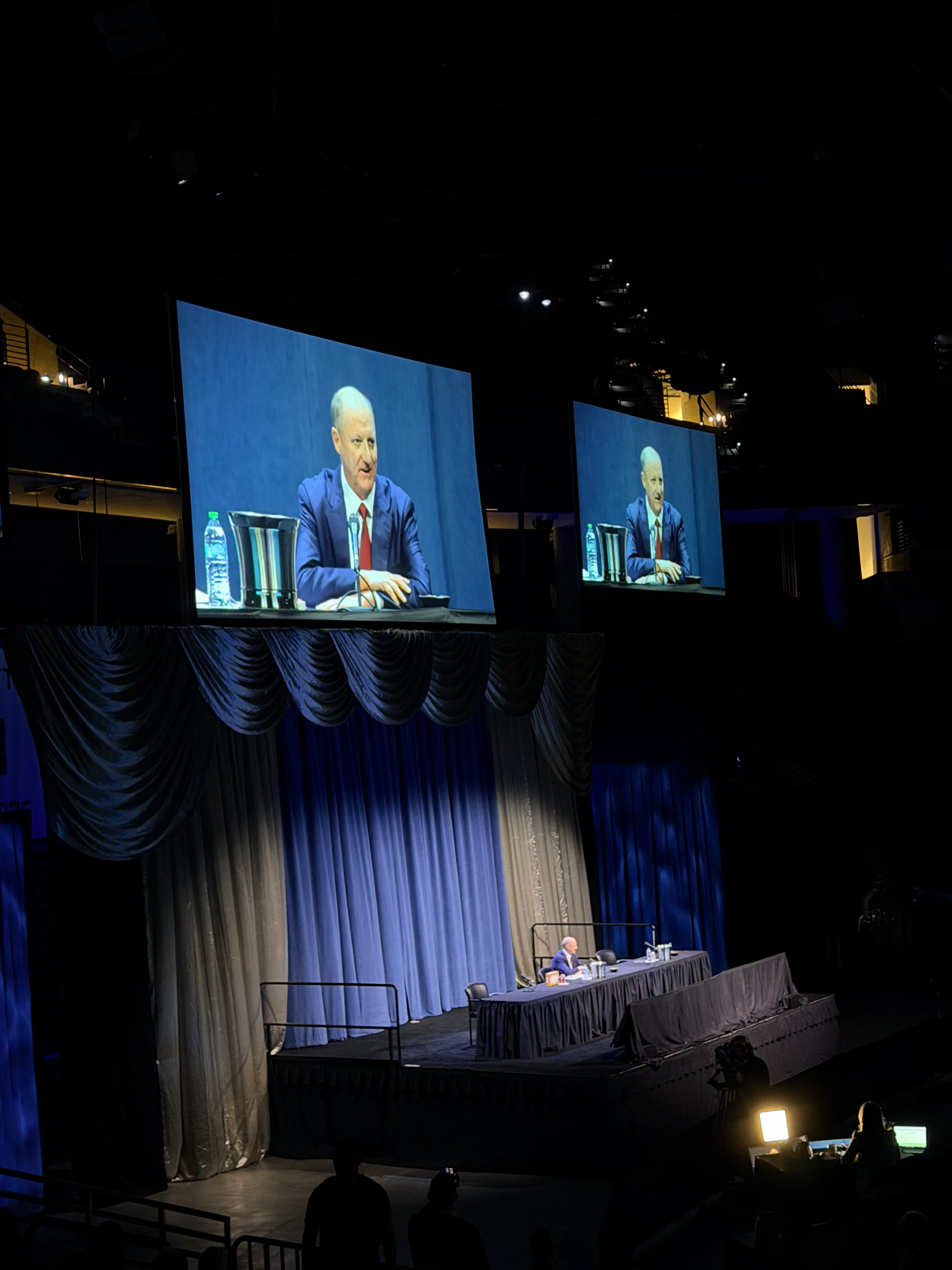
Abel opened his first AGM as chief executive with an empty chair beside him, set with Warren Buffett’s drink of choice, Cherry Coke, and Charlie Munger’s favourite candy.
1. Record cash – signal or dry powder?
The cash pile was a recurring theme throughout the day. Abel highlighted the advantages of Berkshire’s conglomerate model, stressing its ability to shift capital quickly and tax‑efficiently across subsidiaries, and underscored margin of safety as the core lens for capital deployment: taking some risk in return for lower entry valuations and more attractive opportunities. Buffett struck a more cautious tone. In a lunchtime interview on the sidelines of the meeting, he said he does not see an ideal investing environment at present.
2. Portfolio: concentrated, Apple legacy and a more active hand
Abel characterised Berkshire’s equity portfolio as deliberately concentrated around four core holdings – Apple, American Express, Moody’s and Coca‑Cola – complemented by long‑term stakes in the Japanese trading houses. Bank of America, Chevron and Alphabet were highlighted as other significant positions. The Apple stake took centre stage. Apple CEO Tim Cook, who has announced his intention to step down, was in the arena, and Buffett used the occasion to pay personal tribute while spelling out what quoted holdings can bring to Berkshire:
"We turned over 10% of our resources (35 bn USD) 14 years ago, and AAPL is now worth 185 bn USD – and I haven't done a thing." — Warren Buffett on Apple
His point, which he revisited several times, was that listed companies have their place in the portfolio precisely because they demand no operational involvement. Abel, by contrast, signalled he will take a more active role in managing the equity book – adding to or trimming positions when warranted, in close collaboration with Buffett. It marks a subtle shift away from Buffett’s famous “our favorite holding period is forever” posture toward a somewhat more dynamic approach.
A common thread, across sectors, was consumer value. When Buffett explained the Apple investment, he framed it as a consumer franchise rather than a technology bet, and the same logic ran through Abel’s comments on which companies can keep compounding over time.
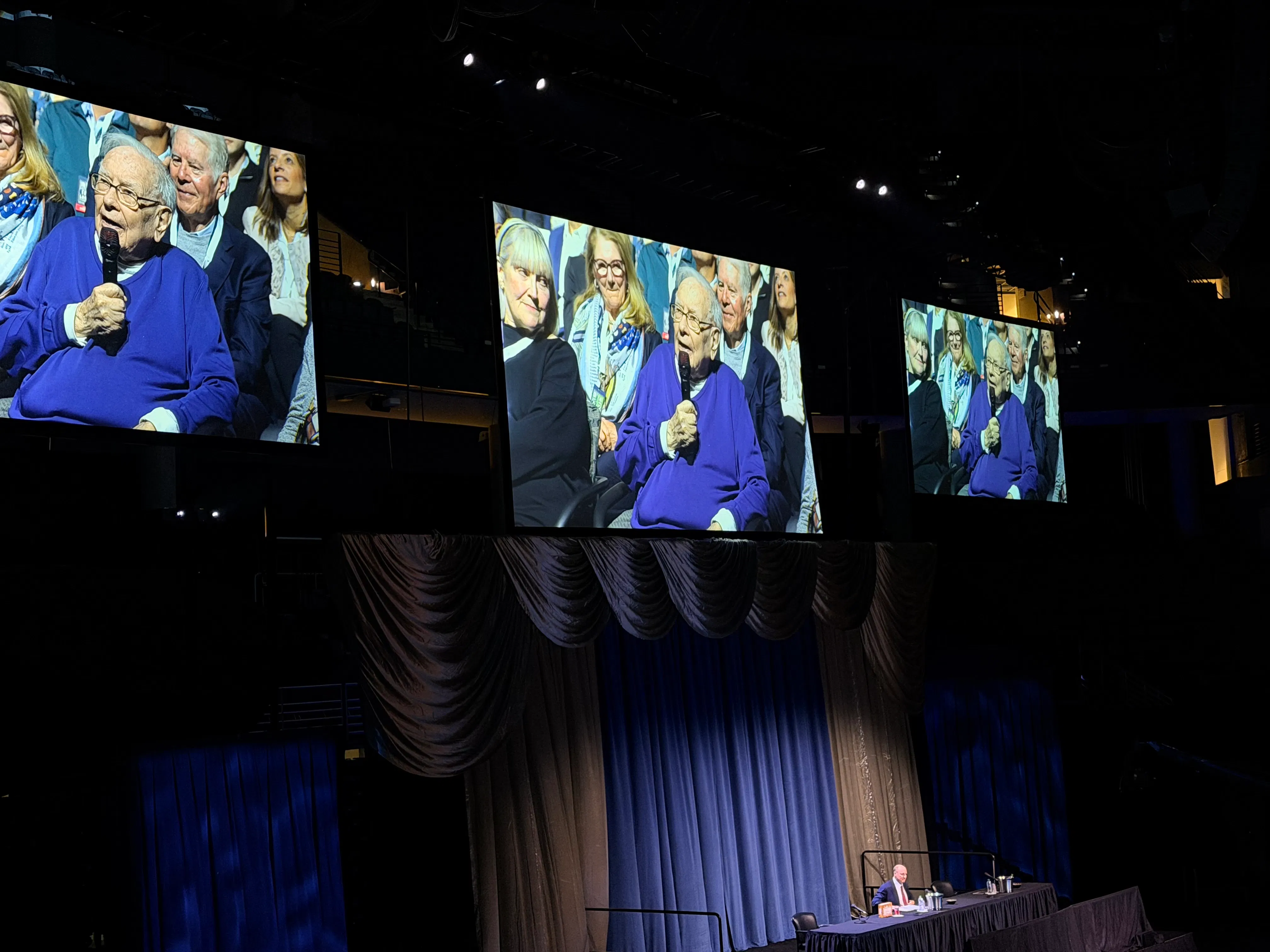
Now 95, Buffett led Berkshire as CEO for six decades; he remains chairman and, this year, participated from the floor.
3. AI is built in‑house – and aimed at operational excellence
AI dominated much of the conversation and set the tone from the outset. The traditional Q&A opened with a deepfake‑generated clip in which an AI version of Buffett posed the question:
“I’m 95 years old and have a large share of my net worth in Berkshire. Why should I remain a long‑term holder of BRK stock?”
Abel’s answer pointed to Berkshire’s unique ability to move capital efficiently between operating companies and to its deliberate resistance to bureaucracy – a force he warned can slowly kill a business. Framing the question through a deepfake was a deliberate way to tee up the day’s AI discussion.
Abel described how AI work is already underway at BNSF, where more than 750 trains run daily and models can help manage track, weather and logistics, and how language models are being used to tackle complex logical problems.
"We're using AI to solve logical problems in our business. But it's all about operational excellence." - Greg Abel
Coming from the operational side of Berkshire – he previously ran Berkshire Hathaway Energy – Abel made clear that operational excellence is his organising principle. AI is a tool, not an end in itself.
"We're not going to do AI for the sake of AI." — Greg Abel
He also stressed governance, human oversight and consistency: ask the same question of an AI model multiple times and the answer should be stable.
4. Operating companies in the spotlight: BNSF, BHE and insurance
One visible shift versus prior years was the greater focus on the operating businesses and their CEOs. Adam Johnson and Katie Farmer both made a strong impression on stage.
At BNSF, Abel was unusually blunt: the railroad has to raise its operational game. Farmer agreed and walked through ongoing improvement efforts and early tangible results. At Berkshire Hathaway Energy, Abel pointed to soaring demand from data centres and hyperscalers as a major structural growth driver. Roughly 15 percent of all natural gas produced in the U.S. is, by his estimate, in some way connected to BHE’s network – a position that gives the company scale as AI‑driven power consumption continues to climb.
In insurance, Ajit Jain painted a less rosy picture of the competitive backdrop. The market has tightened, both from key rival Progressive and from peers more broadly. Recent strong earnings have been flattered by a lull in natural catastrophes, which he stressed is a transient tailwind. In cyber, Berkshire has been deliberately slow as an underwriter; so far few have lost large sums, and pricing is drifting down. Asked how you insure ships transiting the Strait of Hormuz, Jain answered dryly:
"Depends on the price."
Understand the risk, set the right price – the same discipline that underpins Berkshire’s investment decisions.
5. Buffett’s own market view: more casino than church
Over lunch, Buffett likened today’s market to “a church with a casino attached.” In his view, more and more people are flocking to the casino: one‑day options and prediction markets are, he argued, neither investing nor even speculation, but pure gambling.
“We’ve never had people in a more gambling mood than now.” - Warren Buffett
He pointed to a recent case in which a U.S. soldier was charged with using classified information about a military operation in Venezuela to make 400,000 dollars on a prediction market.
Kultur, succession och vad Atle tar med sig
Culture, succession – and what Atle takes home
Berkshire’s culture ran as a through‑line all day. A clip from 1991 was played in which Buffett testified before Congress in the wake of the Salomon Brothers scandal:
"Lose money for the firm and I will be forgiving. Lose a shred of reputation for the firm and I will be ruthless." - Warren Buffett, 1991
Abel reframed that culture with his own shorthand: ABC – Agency, Bureaucracy, Complacency – the three forces Berkshire works hardest to avoid. Asked why investors should own Berkshire, he said the culture is “the bedrock of BRK”, that the company thrives precisely because it despises bureaucracy, and that patience remains one of its greatest strengths.
When pressed on who will be his Charlie Munger, Abel was candid: the Warren–Munger partnership created a kind of magic that will be hard to replicate. But he noted that the broader leadership bench – Adam Johnson, Ajit Jain, Katie Farmer and the other operating CEOs – is already in place. Buffett, for his part, summed up his choice of successor:
"I didn't pick Greg because he was a nice guy. He is very smart about businesses." - Warren Buffett on Greg Abel
On succession planning beyond Abel, Greg said the board knows exactly what to do should anything happen to him or to Ajit Jain, but offered no further detail.
The investment philosophy itself has not changed: understand the business, understand the risks, and ask what the company will look like ten years from now. What has evolved is the rhetoric around execution – a somewhat more active hand in the stock portfolio, a clear commitment to building technical capabilities in‑house, and a CEO who openly flags where operational performance has to improve. If Buffett’s genius lay primarily in capital allocation, Abel’s signature is emerging on the operating side:
"If you think like an owner, you get very good outcomes", som han uttryckte det – och i påminnelsen om att "you have to be able to say no, that's part of management".
And perhaps above all, in the discipline Ajit Jain captured in one line:
"It's very difficult to get people to sit back and do nothing." - Ajit Jain
In a world that constantly rewards activity, doing nothing remains a deliberate discipline – and one of Berkshire’s enduring strengths.
Written by Anna Marcus and Viggo Hanzon


